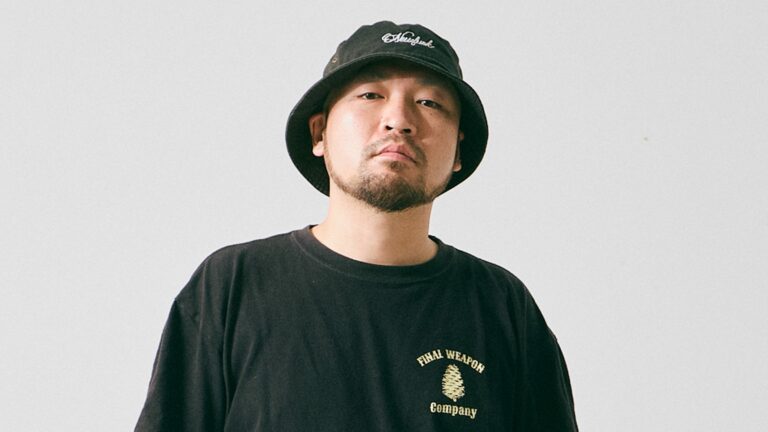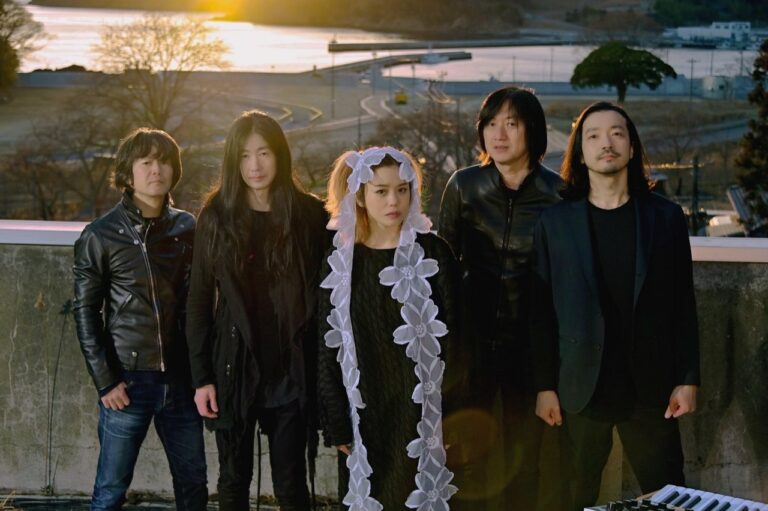



This interview was conducted in Japanese with Night Hawks’ Shuichi Aoki and Chie Iwashita. Their answers have been translated and edited for clarity: repetitions, overlapping dialogue and conversational pauses were removed, but the substance of the original discussion has been preserved.
I have followed Night Hawks since 1994. Thirty years later, I sent Shuichi Aoki and Chie Iwashita a list of questions from France, without knowing quite how far they would take them.
They answered almost everything. The early years in Hokkaido. The record companies that wanted Aoki without his band. The exhaustion that ended each chapter just as it seemed to be working. The current lineup, which has finally allowed him to discover that playing in a band can actually be fun. Even my awkwardly translated question about the “evolution” of Japanese rock survived, although Aoki understandably spent several minutes questioning the word itself.
The result is less a polished career retrospective than forty-three minutes of memories being recovered in real time. Dates become uncertain. Names lead to other names. Difficult periods are met with a laugh, then described with a candour that the old, shortened version of this article largely erased.
Night Hawks before Night Hawks
J-POP streaming: Night Hawks were formed in Hokkaido in the early 1980s. How did the band begin?
Shuichi Aoki: Was it really 1981? That sounds about right. We entered the Sony audition in 1987, but that was much later. Before Night Hawks, I had played in bands including Action!, Dry Duck Window and Override Sensation. After those different projects, we eventually settled on the name Night Hawks.
Some musicians carried over from the previous band. Kudo and Matsumoto joined later, and the first Night Hawks lineup had three members. Kudo left after about a year, then the formation expanded. Kawada came from Akita, Iwao played guitar, and Kumi Tsuchida played keyboards. There were six of us at one point.
I mainly sang, although I also played guitar and probably keyboards. I have done so many different things that I honestly no longer remember every detail.
What shaped the early Night Hawks sound?
Aoki: Whitesnake. We loved Whitesnake.
Before that, I had been deeply into progressive rock, and we played a lot of music in that vein. Once the band became Night Hawks, the progressive element receded and the Whitesnake influence became much stronger. We wanted to be that kind of band.
We covered plenty of Whitesnake songs, along with other artists. But if you only play covers, you remain a cover band. So we began writing original songs in a similar style. They did not all sound like that, of course, but some certainly did.
Looking back, is there one early achievement of which you feel particularly proud?
Aoki: Not really. Nothing in particular comes to mind.
That blunt answer establishes the tone for everything that follows. Aoki does not seem interested in arranging the past into a procession of glorious milestones. The victories happened, but so did everything required to survive them.
“They kept telling me to get rid of the band”
Night Hawks went through long periods of inactivity. What led to them?
Aoki: There was never one single reason. We stopped several times.
Keeping a band going outside a major city was difficult. Relationships became complicated, there were all kinds of problems, and I became completely exhausted. At one point, I was ready to leave Night Hawks. I never announced anything. I simply stopped.
We sometimes continued with guest musicians or support guitarists and drummers, but that did not last long either. Around that time, things were not moving in the direction I wanted. Whatever we did, we could not make our debut.
Every time we spoke to a record company, they said the same thing: “Why don’t you become a solo artist?” They wanted me to abandon the band and make something more pop-oriented.
I had no interest in that. I wanted to be in a band.
Eventually, someone I knew in Tokyo invited me to work as an arranger, so I moved there. Before leaving Hokkaido, I recorded two solo demo tapes, Shuichi Aoki Solo 1 & 2. Some of that material has since resurfaced on YouTube.
Night Hawks remained somewhere in the background. Chie had followed the band for years, then started playing with me in other projects. She eventually asked the obvious question: why was I no longer doing Night Hawks?
Chie Iwashita: I told him, “Let me join. Let’s bring Night Hawks back.”
Aoki: My reaction was more or less, “We could do it once, I suppose.”
An audition organised by Yamaha and Sony arrived at roughly the same time. I was not particularly invested in the idea, but Chie wanted us to apply. We contacted Tetsuya Kudo again, entered the auditions and passed both, although we only reached the regional stage with Yamaha.
Sony contacted us, and I initially refused.
I had already made plans to work alone—not necessarily as a solo artist, but outside the band—and I could not imagine Sony being interested in Night Hawks. The head of Sony’s Sapporo office kept pursuing me. He was incredibly persistent. Eventually, I met the people from Sony in Tokyo, we entered their competition and won the Grand Prix. The contract followed.
I had spent years pushing until I was burned out. Then, just after I had burned out, Night Hawks made their major debut.
It took the recording of the first album for my energy to return.
The dates become slightly tangled in the conversation, but the broad sequence is clear. Night Hawks formed in Hokkaido during the early 1980s and won the CBS/Sony SD Audition before releasing their self-titled major debut album in 1989.
The success did not remove the pressure. It merely changed its source.
Aoki: I seem to have been born under a star that attracts trouble. There were problems inside the band, conflicts with the label and difficulties with management. It never stopped.
Eventually, management said it again: fire the musicians and continue as Shuichi Aoki. We were not selling enough, and everything came back to that proposal.
I still wanted Night Hawks to survive. That became my priority, so I began accepting decisions from management and the record company, even when they were not what I wanted. Almost everything I did was an attempt to keep the band alive.
Then I was exhausted again.
The first period of inactivity before our debut came from burnout. The later one did too. Even during the major-label years, I was already tired.
The years when Night Hawks never officially ended
What did you do while the band was inactive?
Aoki: Chie opened Apple Box, which has now existed for twenty years. Shinji Matsumoto continued working as a bassist, teacher and session musician. I do not know everything Kudo and Matsumoto did during those years, so I cannot speak for them in detail.
I played in Blue Velvet and KINGS. KINGS came from my desire to play hard rock again, but it was completely different from Night Hawks—heavier, with a more Western hard-rock atmosphere. Blue Velvet had another identity of its own.
I also released solo work that combined different things I loved: punk, direct rock songs, ballads and other styles. I have written an absurd number of songs.
Iwashita: Maybe as many as Tetsuya Komuro.
Aoki: Unfortunately, mine did not sell.
In 2000, I started a project called Kaori and released a mini-album. Home recording and desktop music were beginning to receive serious attention at the time, and I wanted to try them. I worked on that until around 2005, then Apple Box occupied much of my time.
There is an entire parallel discography hiding inside this answer: Blue Velvet, the heavier KINGS, solo recordings, Kaori and numerous compositions Aoki has gradually begun sharing online. He dismisses them because they did not sell. Iwashita objects because she has heard how much is there.
Neither wins the argument.
Was the return of Night Hawks planned?
Aoki: We never officially disbanded, so I would not call it a reunion. We never announced that Night Hawks had ended.
If you mean the current activity with Kenta Harada and the other musicians, that happened naturally. We played a few concerts together and it worked.
For many longtime listeners, the most visible change may be Aoki’s position. The man commonly identified as the band’s singer and guitarist now spends more time behind the keyboards. He does not regard that as any great rupture.
Aoki: I love guitar, but I do not need to play it all the time. I love music; guitar happened to be one way of making it.
When Kenta joined, he could already play guitar extremely well. Chie has also become a much stronger guitarist, so I no longer have to cover every part myself. I can move to the keyboards whenever the music needs it. To me, they are simply different instruments.
Kenta Harada and Yoshihiro Ogasawara have music at their core. They enjoy playing what I write, and they are good enough for me to give them considerable freedom. The possibilities have expanded enormously.
The burden on me has decreased. I can do far more, while having to control far less.
Iwashita: And I am having a lot of fun.
Was it difficult to recover the band’s chemistry after such a long interruption?
Aoki: Not really. I usually compose and arrange the main structure myself, so I need musicians capable of bringing that music to life. The members receive what I have written, then interpret parts of it freely. Some elements are fixed, but guitar solos and bass lines can leave room for their personalities.
That was also true in the past. I never dictated every bass line. In that respect, the process has not changed very much.
Night Hawks exists in the present tense
How does the current lineup preserve the original Night Hawks identity while introducing new energy?
Aoki: Every version of Night Hawks has been different. The motivation was different before the debut. The energy changed again after it. Now Kenta and Ogasawara are here, and even when we perform the same composition, it cannot be the same.
Take “Tokyo City Blues.” The musicians playing it today are different, and those who were already there have changed too. Perhaps we have grown. In any case, what each person brings to the music is no longer what it was.
We are not trying to reproduce our old motivation. I am asking what Night Hawks should play now.
Even when we perform an older song, I do not experience it as an old song. It belongs to the present because we are playing it now. I barely remember what the earlier version felt like anyway.
This is where the idea of preserving an “essence” begins to collapse. Aoki does not guard Night Hawks by freezing its sound. He preserves it by remaining the person who decides what the name should mean at a given moment.
That distinction matters when discussing 暗黙の日々 (Anmoku no Hibi). The composition is approximately forty years old, but its official recording belongs entirely to the current formation.
Is rock supposed to evolve?
Why has hard rock remained meaningful across generations of Japanese music?
Aoki: I do not think that is specific to hard rock. Music crosses generations. Good music remains, whatever its genre.
How do you view the evolution of Japanese rock and its effect on the way Japanese music is perceived internationally?
Aoki pauses over the word “evolution” before attempting the rest of the question.
Aoki: Has rock really evolved?
New styles have appeared, certainly. There are more genres and more combinations of genres, but I am not sure that should be called evolution. Music is an art. Increased variety is not necessarily progress from one stage to another.
I have thought about this since I was young: “rock” is an extremely vague word. Its definition changes from one person to another. I do not really know what rock is.
I sometimes hear it in Takuro Yoshida or Yosui Inoue, although people do not necessarily classify them as rock artists. I can feel it in Michael Jackson too. “Billie Jean” hits me with that kind of force.
For me, rock is whatever hits—particularly through rhythm. It can come from Led Zeppelin, Deep Purple, Takuro Yoshida or someone playing down the street. If it strikes me directly, I feel rock in it.
Technology has unquestionably evolved. Instruments, effects, recording methods and production tools have changed. Today, software can create an arrangement at the press of a button. That is neither inherently good nor bad; it belongs to the period in which we live.
Some musicians will be satisfied with that. Others will continue searching for something personal. I am not satisfied with having the work done for me, so I continue doing it myself.
The tools evolve. Art multiplies its forms. Aoki resists the idea that the latter can be measured as a straight line of progress.
It is also difficult not to hear a summary of his career in the answer. Night Hawks survived several versions of the Japanese music industry precisely because Aoki refused the supposedly logical next step whenever it required him to stop making music on his own terms.
The forty-year route to “Anmoku no Hibi”
What inspired 暗黙の日々 (Anmoku no Hibi)?
Aoki: I wrote it about forty years ago, so I cannot honestly remember the original inspiration.
I wanted to make something progressive. I was listening to Kansas and other progressive rock bands, but I did not want to imitate Kansas. I wanted to absorb some of that music and create my own version—progressive, although perhaps not excessively so.
Years later, I heard an old live recording on Chie’s YouTube channel. The emotions attached to the song suddenly returned. My reaction was: “Did I really write something like this?”
The composition remained in my mind.
With Kenta playing guitar, Chie also on guitar and me able to concentrate on keyboards, the current formation could finally do something interesting with it. I had written new material too, but this was the song that made sense.
Everyone could be heard. Everyone had a moment in which to stand out. It gave us hard rock, progressive elements and the kayōkyoku sensibility I have always liked.
I could already imagine how the members would play it. Once I saw that arrangement in my head, I knew we had to record it.
The current performing name, ナイトホークスハラダケンタオガン—rendered in release metadata as Night Hawks Harada Kenta Ogan—compresses that expanded formation into something cheerfully unwieldy. The recording credits Aoki as lyricist, composer and producer, while the live lineup brings together Aoki, Iwashita, drummer Tetsuya Kudo, guitarist Kenta Harada and bassist Yoshihiro Ogasawara. The official release is available here.
For listeners who mainly remember Aoki as a guitarist, Anmoku no Hibi may be disorienting. He knows it.
Aoki: Some people may watch it and wonder, “What on earth is this?” But this is also what I used to do. Next time, perhaps we should make a triple-guitar song.
Was the production process different from your previous releases?
Aoki: It is an old work, so the question does not entirely apply. There was no special new process to compare.
It is a fair correction. The novelty lies neither in the composition nor in some technological reinvention of Night Hawks. It lies in hearing a song written for an earlier version of Aoki’s musical imagination finally performed by the musicians capable of completing it now.
Does the music video carry a particular story or message?
Aoki: No complicated message. I want it to hit you.
Listen without overthinking it. If something in it strikes you and you think, “This is good,” that is enough.
Watch the “Anmoku no Hibi” music video.
Jeff Beck, Chris Squire and one very large stage
If you could collaborate with any musician, living or dead, whom would you choose?
Aoki initially refuses to answer because the list is too long. Asked to limit himself to three names, he eventually chooses Jeff Beck, Chris Squire and Cozy Powell.
His explanation is identical each time: they were irreplaceable.
John Bonham also enters the conversation, while Iwashita chooses John Frusciante and Michael Jackson—although Aoki argues that Jackson should be watched from the audience, not joined onstage.
If Night Hawks could perform anywhere, what venue and what kind of concert would you choose?
Aoki: Madison Square Garden. A huge, spectacular hard-rock show.
No modest club, no carefully reasoned symbolic location. After four decades spent fighting to keep a band when nearly everyone seemed to want only its leader, Aoki allows himself the largest room he can name.
He also says something far less theatrical earlier in the interview: at more than sixty years old, he has finally discovered that being in a band can be enjoyable.
There is no management telling him to dismiss the musicians. No label pushing him towards a solo career. The players around him can carry the music without waiting for instructions on every note. For the first time, Night Hawks gives him freedom instead of asking him to surrender it.
“Right now,” he says, “is the most fun I have ever had in a band.”
Watch the full Night Hawks interview on YouTube.