



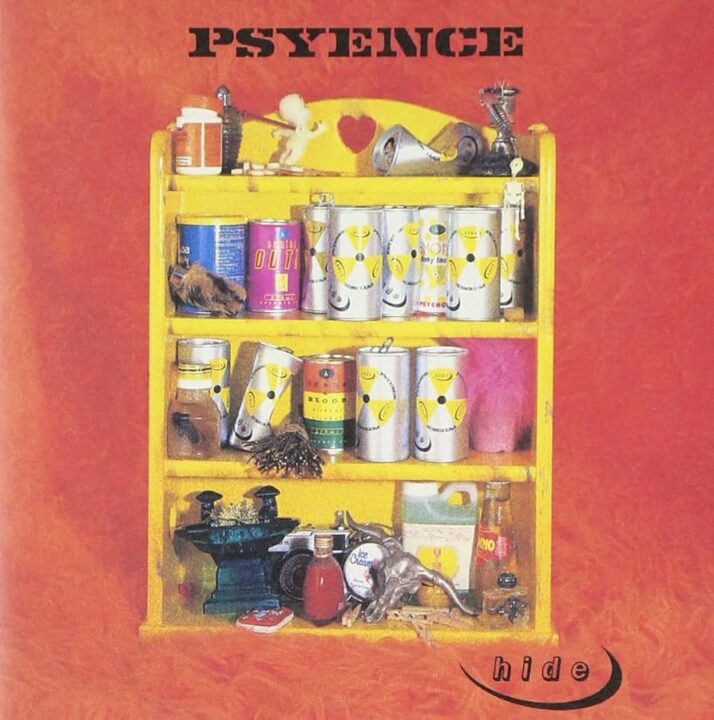
PSYENCE turns thirty today. I measure those years between two images of hide.
In the first, he is alive and I do not know his name.
On February 8, 1997, hide performed “Hi-Ho” on NHK’s POP JAM. I watched from France on JSTV, a channel whose signal was often scrambled. That day, it was clear. A pink-haired man appeared in an improbable outfit, surrounded by dancers, with a song that seemed to have invited rock music to a party.
I knew neither hide nor X JAPAN. I did not know that the guitarist beside him was PATA. I knew nothing about visual kei, the band’s history or hide’s place within it.
I knew that I wanted to hear the song again.
In the second image, eleven years later, I know exactly who hide is. I am at the Tokyo Dome with a delegation of French journalists for X JAPAN’s reunion concerts. The living man once carried to France by a television signal now appears onstage as a hologram.
A great deal happened between those two screens. Much of it began with PSYENCE.
Sixteen tracks, no straight line
The album had been released on September 2, 1996. “Hi-Ho” followed on December 18 as a double A-side with “GOOD-BYE.” By the time of the POP JAM performance, the promotion was still doing its job. It found someone in France who had no idea he was waiting to be found.
“Hi-Ho” became one of the anthems of my life. PSYENCE became one of my favourite albums.
Calling it alternative rock is not incorrect. Believing that this explains anything is the mistake.
The title track enters with swinging brass, somewhere between a nightclub orchestra and a spy-film score. Then the record begins pulling in other directions. “DAMAGE” crushes guitars, programmed rhythm and a distorted voice inside the same machinery. “BACTERIA” is hostile by design; immediately after it, “GOOD-BYE” exposes a melody whose title would carry a weight no one could have anticipated after hide passed away on May 2, 1998.
That is enough sadness for one sentence. PSYENCE is far too alive to be treated as an obituary.
“LASSIE” keeps the dirty looseness of a demo because polishing it would have removed its point. “Hi-Ho” bounces on percussion and communal voices. The remixed “MISERY” opens its arms to pop without asking permission from rock. Even the short instrumental tracks matter. They change the air before hide changes the rules again.
The album does not sound like a musician trying several costumes in front of a mirror. hide commits to every idea while it lasts. Brass must swing. Noise must hurt. A chorus must be allowed to become enormous. Bad taste is welcome when good taste would be boring.
Sixteen tracks. Just over an hour. No straight line.
Yet PSYENCE never sounds anonymous. hide remains visible in every transformation: in his phrasing, his guitar playing, his humour and the pleasure he takes in pushing a song one step past the reasonable stopping point.
The machinery behind the freedom
I.N.A. helped hide build the machinery required for that freedom. Human performances were recorded, cut apart and reconstructed digitally, allowing live instruments and programming to coexist without either pretending to be the other. hide described the method plainly: the smallest possible team, the shortest possible time and the greatest possible density.
The density can be heard, but the album rarely feels heavy with its own ambition. It can be aggressive, silly, melodic or theatrical without stopping to announce a new direction each time.
PSYENCE reached number one on the Oricon album chart. This was not a private laboratory hidden behind X JAPAN. The public went with him.
Thirty years later, the album still refuses the simplified version of hide sometimes presented outside Japan. X JAPAN is essential. Visual kei is essential. Neither tells you why the title track has brass, why “BACTERIA” is followed by “GOOD-BYE,” or why “Hi-Ho” can make a room feel occupied before anyone has entered it.
Listen to the whole album. The collisions are the point.
From JSTV to the Tokyo Dome
I did listen. Then I went looking for the rest.
hide led me to X JAPAN, then much further into Japanese music. The fascination did not remain a private collection of records and television memories. It became JaME. Years later, it became J-POP streaming.
I cannot prove what my life would have looked like if the JSTV signal had been scrambled that day. Perhaps another artist would have opened another door. I only know that hide was there first, or close enough, and that JaME would probably never have taken the same shape without him. J-POP streaming even less so.
JaME is also why the story eventually left my television screen.
I met YOSHIKI in Los Angeles, then brought him to Japan Expo in 2007. The following year, I worked with X JAPAN and accompanied a delegation of French journalists to their reunion concerts at the Tokyo Dome.
And there was hide. Not backstage. Not among the people I could meet. Light projected into an arena large enough to contain the absence.
In 2009, I worked with PATA and Ra at the J.E. Live House. The guitarist I had failed to recognise beside hide on POP JAM was now standing in front of me.
These encounters were never replacements for meeting hide. I did not think of them that way. YOSHIKI was YOSHIKI. PATA was PATA. There was work to do, conversations to have, an event to run.
The other meaning came later.
I wish I had told them that their friend had been important to me. That he was one of the artists who made Japanese music feel like a world I needed to explore. That if I was standing in front of them, working with them, he had something to do with it.
I did not understand that clearly enough at the time.
PSYENCE is thirty years old. “Hi-Ho” has never left me. And I still wish I could have thanked hide.
Main sources: