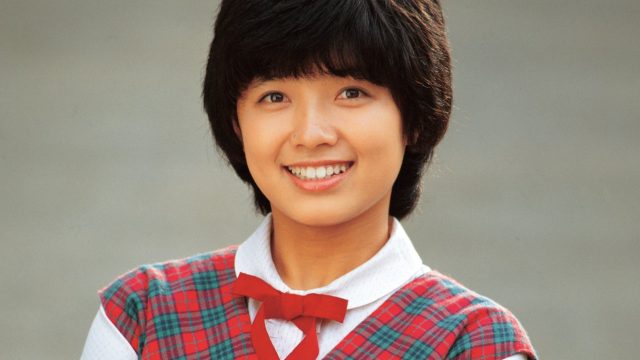

Hiromi Ohta (太田裕美) passed away on November 12, 2026, at the age of 71. Sony Music announced her passing six days later.
Her name will forever be associated with “Momen no Handkerchief” (木綿のハンカチーフ), one of the defining Japanese pop songs of the 1970s. But looking back on her career reveals something more interesting than the story of a singer and her greatest hit.
Ohta belonged to a generation when the boundaries between idols, kayōkyoku, folk and new music were beginning to shift. She had the popularity of an idol, the musical training of a classical singer and the piano-playing habits of a folk artist. She also wrote some of her own material.
None of these descriptions tells the whole story. Perhaps that is precisely what made her different.
A voice she had to learn to accept
In a 2014 interview with Uta-Net, Ohta recalled something that had stayed with her since school. A classmate had once told her that she had a strange voice.
The remark affected how she heard herself for years.
Despite studying classical singing, she never felt particularly suited to opera. Her personal tastes leaned towards very different voices, including the lower, huskier tones of Sade and Lauryn Hill.
Eventually, she came to appreciate one simple fact: nobody else sounded quite like her.
It is an interesting contradiction. The quality that helped make Hiromi Ohta instantly recognisable was not necessarily one she had wanted for herself.
Her journey into professional music was equally unconventional. She trained at music school, joined the School Mates performance group and appeared on NHK's Stage 101 in 1973. Yet she later admitted that she had not grown up with a carefully defined ambition to become a singer.
She simply enjoyed music, particularly playing piano and singing.
Her recording career began in November 1974 with “Amadare” (雨だれ). Written by lyricist Takashi Matsumoto (松本隆) and composer Kyōhei Tsutsumi (筒美京平), it introduced a partnership that would shape her early years.
The song that changed everything
In December 1975, “Momen no Handkerchief” appeared on her third album, Kokoro ga Kaze o Hiita Hi (心が風邪をひいた日), before being rerecorded and released as a single.
The song's construction was unusual. Rather than following a conventional love-song narrative, Matsumoto wrote an exchange between two lovers whose lives were gradually moving in different directions.
The young man leaves for the city. His letters describe an exciting new world. The woman he has left behind asks for something much simpler.
Tsutsumi turned this dialogue into a pop song, with Ohta carrying both sides of the conversation.
Its success belonged to all three artists. Matsumoto provided the story, Tsutsumi the composition and Ohta the voice through which listeners encountered them.
Interestingly, Ohta later explained that she had not approached the single rerecording with a particular new interpretation in mind. She mainly remembered the arrangement becoming more elaborate and being surprised that the album track had been chosen as a single.
There is something refreshing about that admission. A song can acquire enormous cultural importance without its performer having anticipated what it would become.
The success continued with “Akai High Heels” (赤いハイヒール) in 1976 and “Kugatsu no Ame” (九月の雨) in 1977. Ohta also appeared on NHK's Kōhaku Uta Gassen (紅白歌合戦) for five consecutive years, from 1976 to 1980.
But reducing this period to a succession of hits would overlook another part of her work.
Between the idol and the songwriter
Ohta's early albums already contained songs she had written herself. Her 1975 debut album, Magokoro (まごころ), included “Hitorigoto” (ひとりごと) and “Gray & Blue” (グレー&ブルー), both credited to her for lyrics and music.
In other words, songwriting was not something she suddenly discovered after her commercial breakthrough.
Her career gradually moved towards a more album-oriented approach. In a retrospective interview with mora, her former director Ryūzō Shirakawa (白川隆三) explained that the team had wanted to move away from relying so heavily on singles and develop a musical identity closer to new music.
The intention was also practical: to give her a longer artistic life than the traditional idol cycle might allow.
That evolution became visible through changing collaborators and repertoire. In 1979, her own composition “Garasu no Sedai” (ガラスの世代) was released as a single.
The following year brought another important recording, “Saraba Siberia Tetsudō” (さらばシベリア鉄道), written by Matsumoto and composed by Eiichi Ohtaki (大瀧詠一).
Shirakawa recalled that Ohtaki had contacted him from the studio and played the song over the telephone. Ohta's version was released in 1980, with an arrangement by Mitsuo Hagita (萩田光雄). Ohtaki also recorded his own version for A Long Vacation.
It was another meeting between musicians whose contributions would leave a lasting mark on Japanese pop.
And Ohta was not simply passing through their work. She had already begun establishing a place of her own within it.
A career that kept moving
In 1982, Ohta stepped away from her recording career for a period and spent time in New York. She later resumed her musical activities, with live performances becoming an important part of her work again from the early 1990s.
Her subsequent projects showed how much more there was to her repertoire.
In 1998, “Boku wa Kimi no Namida” (僕は君の涙), for which she wrote both lyrics and music, was featured on NHK's Minna no Uta (みんなのうた). In 2004, she began performing with Shōzō Ise (伊勢正三) and Masumi Ōno (大野真澄) in the acoustic trio Nagomīzu (なごみーず).
She also maintained a strong connection with the composers who had accompanied her early career. Her 2014 album tutumikko paid tribute to Kyōhei Tsutsumi.
Even her 45th-anniversary album, Hiromi☆Deluxe (ヒロミ☆デラックス), released in 2019, was not simply a collection of familiar recordings.
Alongside new versions of “Momen no Handkerchief” and “Saraba Siberia Tetsudō”, it included new material produced by Hyadain (ヒャダイン) and “Sakurazukiyo” (桜月夜), a song written and composed by Ohta herself.
At a point when she could easily have relied on nostalgia, she was still recording new music.
What remains
It would be tempting to describe Hiromi Ohta as an artist who broke every rule. That would probably be an exaggeration.
Her career was shaped by important songwriters, composers, arrangers and producers. Their contributions deserve recognition, just as her own do.
What makes her story distinctive is how naturally she occupied a space between musical traditions that were often presented as separate.
She could be an idol without abandoning the piano, an interpreter without giving up songwriting, and a familiar voice without being confined to her earliest successes.
There is also something worth remembering about the way she spoke of her career. In interviews, she rarely seemed interested in making herself the centre of a grand artistic narrative. She acknowledged the people who had written for her, laughed about her own uncertainties and continued to approach music with curiosity.
The voice she once struggled to appreciate became the thread connecting more than five decades of songs.
For listeners discovering Hiromi Ohta today, “Momen no Handkerchief” remains an excellent starting point.
It should not be the last stop.