
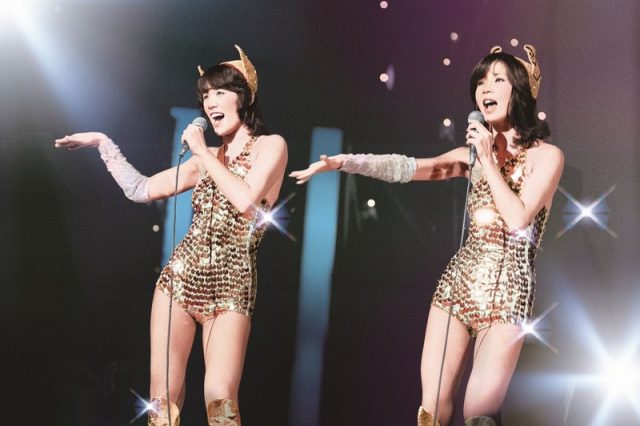
Long before TikTok and its viral dance challenges, Japanese children were already learning choreographies in front of a screen. In the late 1970s, two young women from Shizuoka turned this practice into a nationwide phenomenon: Pink Lady (ピンク・レディー).
Having made their debut on August 25, 1976, with “Pepper Keibu” (ペッパー警部), Mie (ミイ) and Kei (ケイ) released their second single, S・O・S, just three months later, on November 25. In February 1977, it became their first Oricon number one, beginning a run of nine consecutive chart-topping singles that would continue through Chameleon Army (カメレオン・アーミー).
A song designed to be seen
Written by Yu Aku (阿久悠) and composed and arranged by Shunichi Tokura (都倉俊一), “S・O・S” opens with an unusual sound: a Morse-code distress signal. As recording engineer Teruo Yamaguchi recalled in a September 2026 interview with Tokura, the sound was created using an ARP analogue synthesizer recently acquired by Victor’s recording studio.
The lyrics warn young women about the dangers of trusting men too easily, while the repeated title and energetic choreography turn that warning into a playful pop performance.
The contrasting approaches of Aku and Tokura, the work of choreographer Hajime Doi (土居甫) and the remarkable synchronisation of Mie and Kei gave Pink Lady a distinctive musical and visual identity.
Children enthusiastically reproduced their routines at home and at school. Knowing a Pink Lady song often meant knowing how to dance to it.
The similarities with today’s dance challenges are striking. Fifty years before social media became a major promotional tool for the music industry, television audiences were already turning choreographies into shared popular experiences.
A new generation answers the call
On August 26, 2026, Victor Entertainment released Pink Lady Densetsu Now and Forever -50th Anniversary Tribute Album- (ピンク・レディー伝説 Now and Forever), bringing together artists from different generations of Japanese music.
“S・O・S” was entrusted to singer-songwriter AKASAKI and instrumental trio H ZETTRIO. In a statement accompanying the music video, AKASAKI explained how he incorporated playful vocal harmonies while adapting the song to his own vocal style.
Comparing the two versions fifty years apart offers an interesting opportunity to rediscover the songwriting behind the phenomenon. Beyond the colourful costumes, television appearances and spectacular sales figures, Pink Lady’s repertoire contains melodies and musical ideas that contemporary artists can still make their own.
And if you are discovering Pink Lady today, “S・O・S” is a particularly good place to start. Just make sure to watch one of their original television performances, too. Discover more of the Japanese music of 1976 in the selection below.