
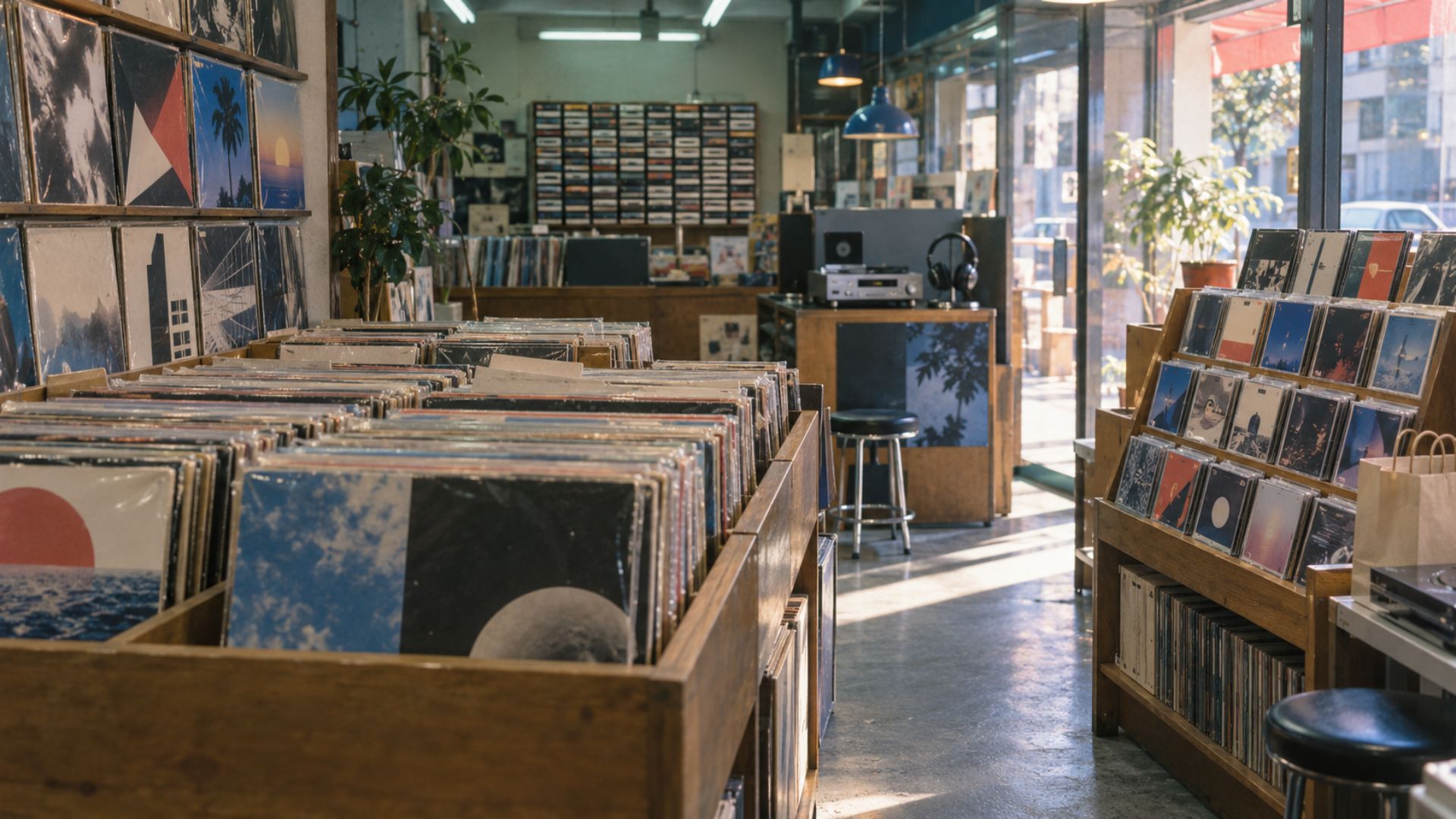

According to the Recording Industry Association of Japan, 45.12 million 12-centimetre CDs and 42.751 million LPs were manufactured in Japan in 1986. CD production had overtaken LP production for the first time. Vinyl remained important, cassettes were still common and 7-inch singles continued to drive much of the pop business, but the balance was changing.
Several albums made that change visible. 渡辺美里 (Misato Watanabe) released a double album at 19. 安全地帯 (Anzen Chitai) filled three LPs or two CDs with 36 tracks. 吉田美奈子 (Minako Yoshida) financed a CD herself and sold 3,000 copies. New recording tools also changed the work being done inside studios, sometimes after considerable resistance from the musicians using them.
The year cannot be reduced to a format. 松田聖子 (Seiko Matsuda) won the Album Grand Prix. BOØWY released two major albums eight months apart. Japanese metal continued its push overseas, early Japanese rap found its way onto an album, orchestral Dragon Quest music left the game console, and 吉村弘 (Hiroshi Yoshimura) released an ambient record whose international reputation would grow decades later.
The 50 albums below were selected for four reasons: their impact in 1986, the artistic or industrial change they represented, their influence, or their importance to a scene poorly reflected in the annual sales charts. This is an editorial selection, presented chronologically. It is not a ranking.
January to March
1. VOW WOW — III
Produced by Tony Platt, VOW WOW’s third album was part of a serious attempt to build a career outside Japan. The band moved to the United Kingdom later in 1986 and worked from there for several years. III records the moment when Japanese heavy metal began approaching overseas expansion as a practical project, with international production, management and touring decisions behind it.
2. 矢野顕子 (Akiko Yano) — 峠のわが家 (Tōge no Wagaya)
This was Akiko Yano’s first original album for MIDI and was co-produced with 坂本龍一 (Ryuichi Sakamoto). Sony’s retrospective describes it as a return towards jazz after her techno-pop period. That direction makes Tōge no Wagaya useful when looking at 1986: electronic production was spreading, yet Yano used it within a looser musical language instead of following the dominant pop model.
3. ローザ・ルクセンブルグ (Rosa Luxemburg) — ぷりぷり (Puri Puri)
Rosa Luxemburg were active for only around a year and a half, but their first album became a lasting reference in Japanese rock. The Kyoto group combined unusual rhythms, vernacular language and elements drawn from older Japanese music without resembling the bands then moving towards arenas. Their influence continued through どんと (Donto) and BO GUMBOS after the group split.
4. PINK — 光の子 (Hikari no Ko)
PINK’s second album came from a six-member group working between new wave, funk and detailed studio production. Interviews published in 1986 show how strongly its members wanted to establish an identity of their own and escape constant comparisons with foreign bands. Hikari no Ko represents the ambitious studio culture developing outside the year’s most visible pop and rock successes.
5. BOØWY — JUST A HERO
JUST A HERO established the musical identity that would take BOØWY from rapid growth to mass success. The group played its first Nippon Budokan concert later that year. Its place in subsequent Japanese rock polls and critical lists also separates the album’s reputation from the scale of the BOØWY phenomenon: this is the record most often retained as the group’s central artistic statement.
6. THE SQUARE — S・P・O・R・T・S
Japanese fusion had a large audience in the 1980s, and S・P・O・R・T・S contains one of its most durable compositions. “TAKARAJIMA,” written by 和泉宏隆 (Hirotaka Izumi), appeared here in its first studio version and remained a standard in THE SQUARE’s repertoire. The album gives instrumental music its proper place in a year too often summarised through idols and rock bands.
7. おニャン子クラブ (Onyanko Club) — 夢カタログ (Yume Catalogue)
Yume Catalogue reached number one while Onyanko Club was reshaping the relationship between television and idol pop. The group’s regular presence on 夕やけニャンニャン (Yūyake Nyan Nyan), its changing membership and its many solo and sub-unit releases created an expanding serial format around the music. That system was one of the major facts of Japanese popular culture in 1986.
8. 岡田有希子 (Yukiko Okada) — ヴィーナス誕生 (Venus Tanjō)
Yukiko Okada’s fourth and final studio album was built around an unusually strong group of writers and composers. EPO, Ryuichi Sakamoto, 大貫妙子 (Taeko Onuki) and かしぶち哲郎 (Tetsuro Kashibuchi) all contributed to the project. Venus Tanjō documents Okada’s development as an interpreter and deserves to be discussed through that work, without allowing the tragedy that followed its release to consume it.
9. 大貫妙子 (Taeko Onuki) — Comin’ Soon
Taeko Onuki conceived Comin’ Soon as music that adults could listen to with children. It brought together songs linked to NHK’s みんなのうた (Minna no Uta), an illustrated book and arrangements by Ryuichi Sakamoto, 清水信之 (Nobuyuki Shimizu) and 大村憲司 (Kenji Omura). The result connects author pop, children’s media and commissioned music without treating them as separate areas of work.
10. LOUDNESS — SHADOWS OF WAR
LOUDNESS recorded SHADOWS OF WAR with producer Max Norman after signing with Atlantic and entering the American album market. The related international edition, LIGHTNING STRIKES, used a different title, running order and mix. Those changes show how overseas expansion worked in practice: the band had broken through, but its Japanese material was still being adjusted for another market.
April to June
11. 吉村弘 (Hiroshi Yoshimura) — GREEN
GREEN was one of Hiroshi Yoshimura’s works of environmental music, composed to shape a place as much as to occupy a listener’s full attention. The album remained scarce for years before its reissue and international recognition made it a common entry point into Japanese ambient. Its importance to 1986 is mainly retrospective, which is also why it belongs in this selection: contemporary sales do not measure every lasting record.
12. 聖飢魔II (SEIKIMA-II) — THE END OF THE CENTURY
SEIKIMA-II’s second “grand scripture” includes “蝋人形の館 (Rōningyō no Yakata),” one of the group’s best-known songs. The band combined heavy metal with elaborate demonic characters and understood how to carry that presentation into mainstream television. The concept attracted attention, while the musicianship gave it enough substance to survive after the initial surprise had passed.
13. 坂本龍一 (Ryuichi Sakamoto) — 未来派野郎 (Futurista)
Ryuichi Sakamoto drew on Italian Futurism while working extensively with the Fairlight CMI. Sampling shaped both the construction and the subject of the album. Official retrospectives place Futurista at the stage when his solo identity became fully independent from YMO, following the more transitional 音楽図鑑 (Ongaku Zukan).
14. 山下達郎 (Tatsuro Yamashita) — POCKET MUSIC
Warner’s account of POCKET MUSIC describes Tatsuro Yamashita struggling with digital recording and computer music during its production. The album therefore documents the technical transition from the perspective of a musician whose standards had already been formed through analogue studio work. It became one of the year’s major commercial albums and received recognition at the Japan Record Awards.
15. 芸能山城組 (Geinoh Yamashirogumi) — 輪廻交響楽 (Ecophony Rinne)
The four-part Ecophony Rinne combines collective voices, gamelan, ecological ideas and audio technology. Its later role in Japanese film history is well documented: the album convinced 大友克洋 (Katsuhiro Otomo) to ask Geinoh Yamashirogumi to create the music for AKIRA. The connection matters because the methods and scale associated with that later score were already present here.
16. 松田聖子 (Seiko Matsuda) — SUPREME
The Japan Record Awards named SUPREME the Album Grand Prix winner of 1986. It also reached number one and includes “瑠璃色の地球 (Ruriiro no Chikyū),” which became one of Seiko Matsuda’s most enduring songs. Its success confirms that idol production and a coherent album project were fully compatible at the centre of the Japanese music business.
17. TM NETWORK — GORILLA
TM NETWORK used its third album to establish the term “FANKS,” which referred to both its audience and the group’s mixture of funk and punk. GORILLA developed the balance between programmed sound and band performance that would soon support Self Control and “Get Wild.” It captures the working model immediately before the group’s commercial breakthrough.
18. 薬師丸ひろ子 (Hiroko Yakushimaru) — 花図鑑 (Hana Zukan)
Flowers provide the organising idea for Hana Zukan, whose songs were supplied by a broad range of writers. The album’s identity comes from the choice of material, its sequence and Hiroko Yakushimaru’s interpretation. It is a useful example of how an interpreter could shape an album as a complete work without being its sole writer or composer.
19. 角松敏生 (Toshiki Kadomatsu) — TOUCH AND GO
TOUCH AND GO was recorded through Japanese and New York studio networks and received an album award from the Japan Record Awards. Toshiki Kadomatsu was already operating as a singer, songwriter, arranger and producer, roles that would become increasingly important to his career. The album reflects the amount of planning and specialist work behind the polished pop and funk associated with him.
20. 少年ナイフ (Shonen Knife) — PRETTY LITTLE BAKA GUY
Shonen Knife released its third album through Zero Records in Japan before it appeared in the United States in October 1986. The group was also included on the Sub Pop 100 compilation that November. These releases document an early international indie route for a Japanese band several years before alternative rock became a large global market.
21. SION — SION
SION’s first major-label album arrived at the same time as the single “俺の声 (Ore no Koe).” It also includes early songs such as “コンクリート・リバー (Concrete River)” and “SORRY BABY,” which remained central to his catalogue. The debut established a songwriter whose rough voice and direct writing offered another form of Japanese rock beside the year’s rapidly expanding bands.
22. 菊池桃子 (Momoko Kikuchi) — ADVENTURE
Momoko Kikuchi’s third album has since been reissued internationally and presented as a city pop classic. That later category should not obscure its original place within idol pop. Its sophisticated writing, arranging and studio production reached a large audience through the idol market itself.
23. P-MODEL — ONE PATTERN
ONE PATTERN was P-MODEL’s seventh album and its last before the group entered a long hiatus. By 1986, electronic pop had become common in Japan, but Susumu Hirasawa’s writing and production remained difficult to absorb into the mainstream version of that sound. The album keeps the earlier Japanese new wave scene present in the year’s history.
24. DEAD END — DEAD LINE
DEAD END released its first album independently before moving to a major label. DEAD LINE helped develop the darker and more theatrical side of Japanese hard rock and metal that would influence later musicians, including many associated with visual kei. Its initial impact on the independent market is just as important as the labels applied to it afterwards.
July to September
25. 中山美穂 (Miho Nakayama) — SUMMER BREEZE
Miho Nakayama’s third album began an important collaboration with Toshiki Kadomatsu and included the original version of “You’re My Only Shinin’ Star” before the song became a later hit. SUMMER BREEZE marks an early stage in Nakayama’s development from a new idol towards a singer with a more clearly defined musical identity.
26. 渡辺美里 (Misato Watanabe) — Lovin’ you
Misato Watanabe was 19 when she released this double album. Lovin’ you reached number one, placed seventh in the annual album chart according to her official site, and received recognition at the Japan Record Awards. Its length is part of its importance: a young singer was given two discs on which to establish a repertoire and identity.
27. PSY・S — PIC-NIC
PSY・S brought together sound designer 松浦雅也 (Masaya Matsuura) and singer CHAKA. Their second album used electronic production within direct pop songs while leaving room for CHAKA’s distinctive phrasing. Matsuura’s later role in the development of rhythm games gives the duo an additional historical connection, but PIC-NIC already stands as a major Japanese electronic pop album of its period.
28. KUWATA BAND — NIPPON NO ROCK BAND
桑田佳祐 (Keisuke Kuwata) formed KUWATA BAND while Southern All Stars were on pause. The group’s only studio album was performed entirely in English, became one of the year’s major sellers and received recognition at the Japan Record Awards. Its title and language reflect the continuing importance of American and British rock as reference points for Japanese musicians in 1986.
29. 1986 OMEGA TRIBE — Navigator
The Omega Tribe project was rebuilt around a new singer, カルロス・トシキ (Carlos Toshiki), and announced that change in its new name. “君は1000% (Kimi wa 1000%)” gave 1986 OMEGA TRIBE an immediate hit, while Navigator established the revised group across a full album. Its current association with city pop followed a successful relaunch in the Japanese mainstream.
30. テレサ・テン (Teresa Teng) — 時の流れに身をまかせ (Toki no Nagare ni Mi wo Makase)
Teresa Teng was a Taiwanese artist with a major career across East Asia. This original Japanese-market album belongs to Japanese music history because it was central to her work in Japan. The title song became one of her signatures and received the composition award at the Japan Record Awards. Its presence also acknowledges how much Japanese popular music has been shaped by artists and audiences moving across national borders.
31. 中森明菜 (Akina Nakamori) — 不思議 (Fushigi)
Fushigi was Akina Nakamori’s first fully self-produced album. Its mix deliberately places her voice inside the music instead of keeping it clearly in front, an unusual decision for one of Japan’s leading idol singers. The album reached number one, giving a demanding concept record a large mainstream audience and establishing Nakamori’s authority over her own recordings.
32. 久石譲 (Joe Hisaishi) — 天空の城ラピュタ サウンドトラック 飛行石の謎 (Tenkū no Shiro Rapyuta Soundtrack: Hikōseki no Nazo)
Joe Hisaishi’s soundtrack accompanied Studio Ghibli’s first feature film and continued his collaboration with 宮崎駿 (Hayao Miyazaki). The album was released on LP and cassette in August, followed by CD in September, and includes “君をのせて (Kimi wo Nosete).” Its long life outside the film shows how soundtrack albums became part of popular listening and shared musical memory.
33. 浜田省吾 (Shogo Hamada) — J.BOY
J.BOY was a double album that spent several weeks at number one and received recognition at the Japan Record Awards. Shogo Hamada used its length to connect personal writing with work, inequality and the social atmosphere around him. The album became one of the clearest signs that Japanese rock could command the mainstream while addressing an adult audience.
34. 浜田麻里 (Mari Hamada) — PROMISE IN THE HISTORY
Mari Hamada wrote all the lyrics for her sixth album and worked with musicians from the Japanese hard rock scene. The record reached the top ten of the LP chart. Her role as writer and lead artist is central to its inclusion: PROMISE IN THE HISTORY places a woman’s authorship and voice within the development of Japanese metal, where historical accounts have often focused on male bands.
35. 吉田美奈子 (Minako Yoshida) — BELLS
Minako Yoshida produced BELLS herself and sold the original CD in a run of 3,000 copies. Some promotional accounts have called it the world’s first independent CD, a claim that is difficult to establish conclusively. The verified facts already make it significant: an established Japanese songwriter used the new format to distribute an album outside the usual major-label process.
36. CASIOPEA — SUN SUN
Guitarist 野呂一生 (Issei Noro) produced SUN SUN, with Carlos Alomar contributing as a musician and composer. CASIOPEA had already developed a recognisable form of Japanese fusion, so the international collaboration did not require the group to rebuild its identity. The album reflects a mature scene working directly with musicians from major American and British studio networks.
37. いとうせいこう (Seiko Ito) & TINNIE PUNX — 建設的 (Kensetsuteki)
Kensetsuteki is best described as one of the foundational albums of Japanese rap. Calling it the first depends on definitions that obscure the work itself. Seiko Ito, 高木完 (Kan Takagi), 藤原ヒロシ (Hiroshi Fujiwara) and ヤン富田 (YAN TOMITA) were adapting rap to Japanese language, available equipment and a scene that was still very small. The album records those early solutions.
October to December
38. すぎやまこういち (Koichi Sugiyama) / 東京弦楽合奏団 (Tokyo String Ensemble) — 組曲「ドラゴンクエスト」 (Suite Dragon Quest)
Koichi Sugiyama conducted an ensemble formed from selected members of the NHK Symphony Orchestra for the first orchestral album based on the original Dragon Quest. The original title is Suite Dragon Quest; later recordings used Symphonic Suite. This release helped establish game music as repertoire that could be arranged, performed and sold independently from the game.
39. REBECCA — TIME
REBECCA’s fifth album reached number one and became a long seller. NOKKO’s role at the front of one of Japan’s biggest rock bands was important in a market where women were still often treated as solo pop or idol singers. TIME showed that a female-fronted group could operate as a central commercial force in Japanese rock.
40. THE ALFEE — AGES
Rolling Stone Japan describes AGES as THE ALFEE’s first full concept album. It was released in the same year that the band played to 100,000 people at Tokyo Bay Area. The two events document different sides of THE ALFEE’s position in 1986: a more structured album project and the ability to stage rock on a very large scale.
41. BOØWY — BEAT EMOTION
BOØWY released BEAT EMOTION eight months after JUST A HERO. The earlier album established the group’s artistic identity; the new record turned its rapid growth into mass commercial success. Both are included because they document separate stages reached within the same year. By November, BOØWY were setting the model followed by many Japanese rock bands that came after them.
42. 中島みゆき (Miyuki Nakajima) — 36.5℃
Miyuki Nakajima co-produced her fourteenth album with 甲斐よしひろ (Yoshihiro Kai). Several major arrangers contributed, and the record was mixed at the Power Station in New York. 36.5℃ shows an established songwriter incorporating the studio sound of the mid-1980s while keeping her writing and interpretation at the centre of the album.
43. THE STREET SLIDERS — 天使たち (Tenshi-tachi)
佐久間正英 (Masahide Sakuma) produced the fifth STREET SLIDERS album, which Michael Zimmerling mixed. The group’s blues-based rock remained distinct from the cleaner and faster style associated with BOØWY, despite sharing the same expanding market. Tenshi-tachi arrived shortly before THE STREET SLIDERS played their first Nippon Budokan concert in early 1987.
44. ムーンライダーズ (Moonriders) — DON’T TRUST OVER THIRTY
Moonriders released their eleventh album before beginning a five-year hiatus. Its title addresses ageing with humour and unease from within a group that had helped shape Japanese new music since the 1970s. The album closes the first part of their career and links that earlier generation to the younger new wave and rock scenes around it.
45. 松任谷由実 (Yumi Matsutoya) — ALARM à la mode
Yumi Matsutoya’s eighteenth original album reached number one. Its LP, cassette and CD editions were all released on the same day, a useful detail in a year of changing formats. An artist whose annual albums had become fixtures of the Japanese market was now addressing listeners across three formats at once, with none yet treated as an afterthought.
46. あぶらだこ (Aburadako) — あぶらだこ (Aburadako), the “Blue Album”
This was Aburadako’s second self-titled album, commonly identified by its blue sleeve. The group’s 1985 debut is the “Wood Album,” and the two are often confused. The 1986 record moves hardcore punk into irregular rhythms, dense language and structures that resist conventional song form. Its later critical reputation gives the Japanese underground a necessary place in this account of the year.
47. 佐野元春 with THE HEARTLAND (Motoharu Sano with THE HEARTLAND) — Café Bohemia
THE HEARTLAND provided all the accompaniment on this album and joined Motoharu Sano in the artist credit for the first time. Café Bohemia expanded his writing through rock, pop and several Black musical influences, supported by a band that had developed a clear collective identity. The credit accurately reflects how important that group had become to the work.
48. 安全地帯 (Anzen Chitai) — 安全地帯V (Anzen Chitai V)
Anzen Chitai V contains 36 tracks and was issued as a triple LP and double CD. The size of the project reflects both the group’s commercial position and the additional playing time available on CD. It is the most literal example in this selection of the album expanding during the transition between formats.
49. 中森明菜 (Akina Nakamori) — CRIMSON
Nakamori’s second number-one album of 1986 was constructed around five compositions by 竹内まりや (Mariya Takeuchi) and five by 小林明子 (Akiko Kobayashi). The equal division gives CRIMSON a clear internal design while placing Nakamori’s interpretation at its centre. Its later association with city pop has added another audience without changing the album’s original strength as a carefully directed idol record.
50. 喜多郎 (Kitaro) — 天空 (Tenku)
Tenku began Kitaro’s worldwide agreement with Geffen and marked the start of his American album career. His route abroad differed from the hard rock and metal strategies pursued by LOUDNESS and VOW WOW: Kitaro entered an international market for synthesizer and new age music. The album completes the picture of Japanese musicians testing several forms of overseas distribution in the same year.


