
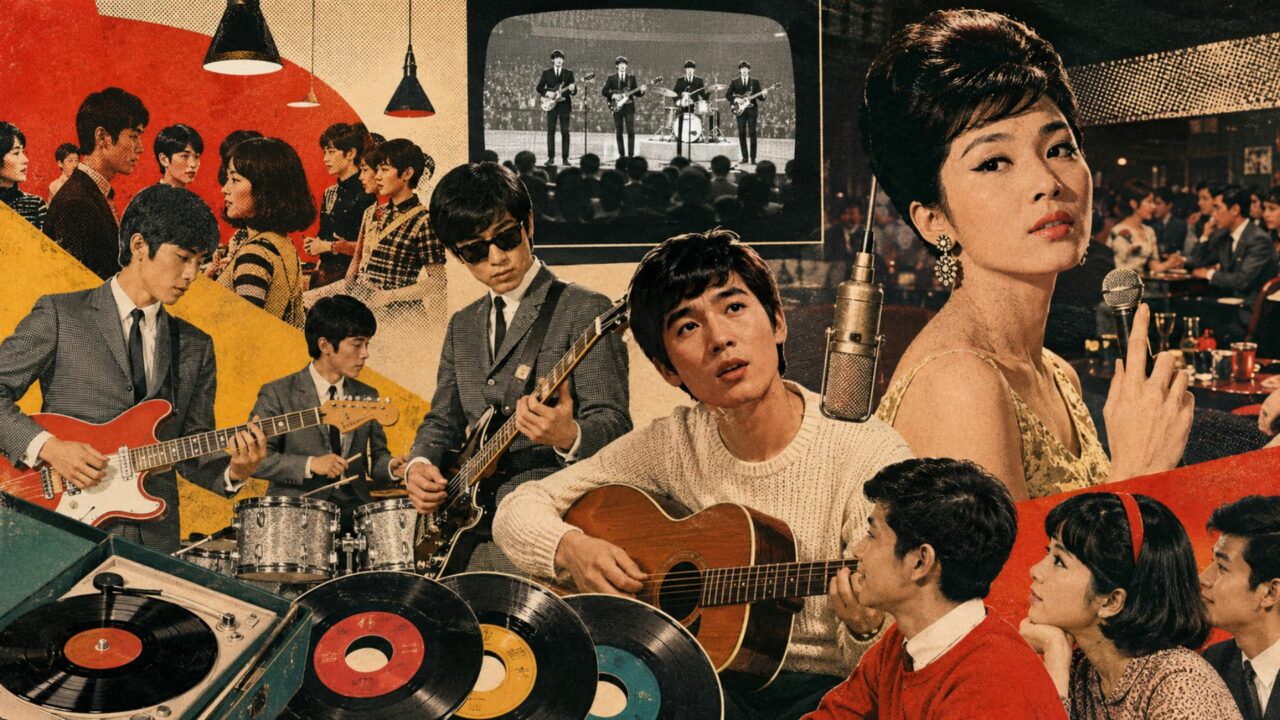
By the time the Beatles walked onto the stage of the Nippon Budokan, Japanese music had already begun to change.
The band played five concerts there between June 30 and July 2, 1966. The first rock concerts held in a venue devoted to martial arts sparked protests, required extraordinary security and drew a 56% television rating. The image was too powerful to forget: four young men from Liverpool, electric guitars, thousands of teenagers and a Japan supposedly overwhelmed by Western rock.
It eventually swallowed the rest of the year.
Sixty years later, the Beatles’ arrival is still often presented as the moment Japanese popular music suddenly changed course. They mattered. Their influence on bands, the industry and the imagination of young people is beyond serious dispute. But they did not carry a revolution into Japan with their luggage.
They arrived just as it was becoming impossible to contain.
The guitars were already playing
The calendar of 1966 does not sit comfortably with the story of a June miracle.
On February 1, The Spiders released No No Boy, composed by Hiroshi Kamayatsu. In March, Jackie Yoshikawa and His Blue Comets issued the first, English-language version of Aoi Hitomi — 青い瞳(あおいひとみ). The record brought them nationwide attention several months before the Beatles set foot in Tokyo.
On April 5, Mike Maki released Bara ga Saita — バラが咲いた(ばらがさいた). An acoustic guitar, a Japanese song written by Kuranosuke Hamaguchi and soon sung everywhere: local folk music had found one of its first major routes into the mainstream.
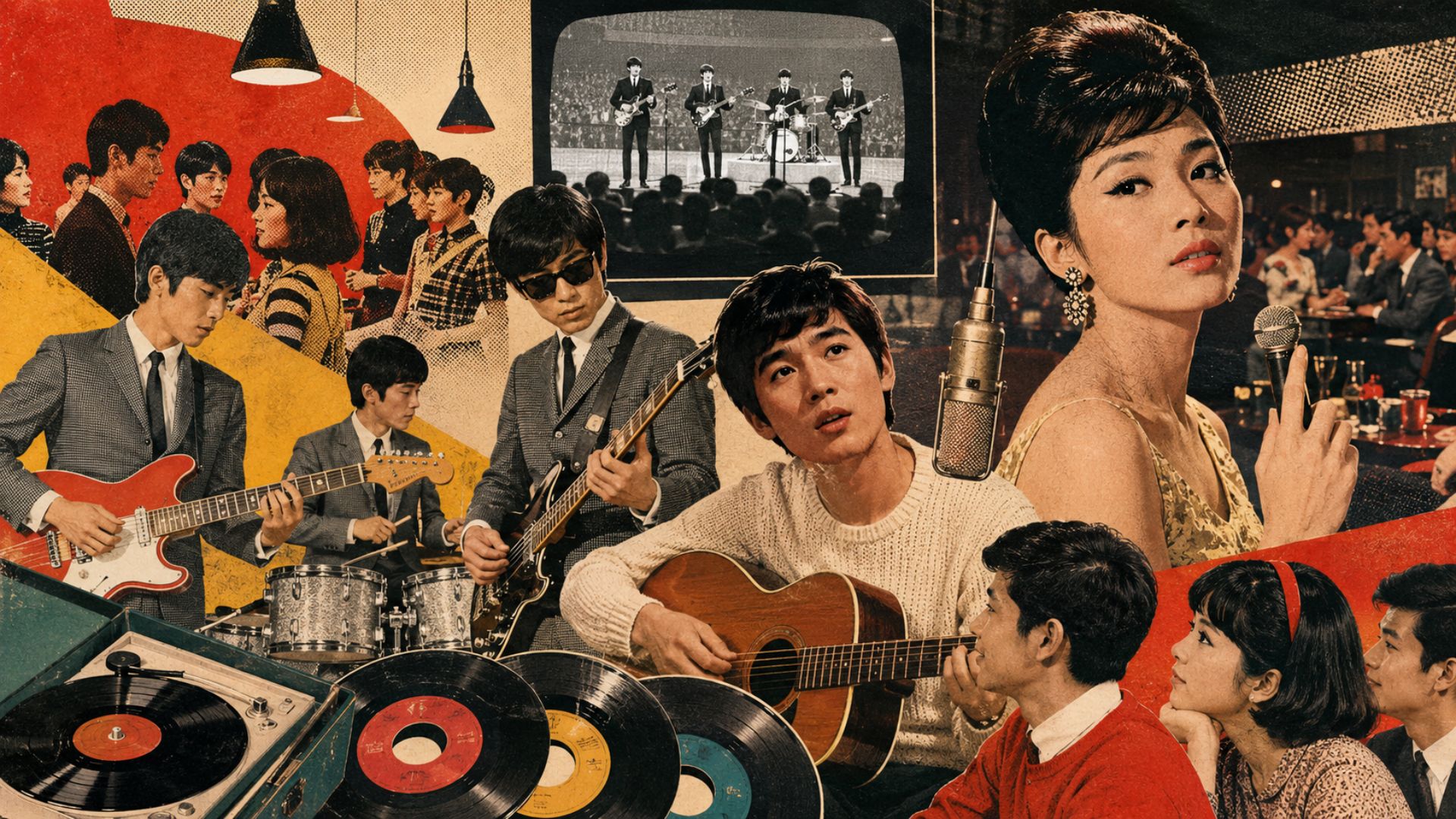
Japan was not standing still outside the Budokan, waiting for June. The eleki boom, fuelled in part by the success of The Ventures, had already put electric guitars in people’s hands. Bands were playing in clubs, cabarets, American military bases and concert halls. The Beatles brought something else: a global embodiment of a generation that could write, play, sing and form a band as if founding a small republic.
They accelerated the movement without inventing it.
The final drop made the onsen overflow. It had not filled the pool.
When the guitars learned Japanese
The decisive change may have happened less at the Budokan than inside Japanese recording studios.
On July 10, eight days after the Beatles’ final concert, the Blue Comets released a Japanese-language version of Aoi Hitomi. The move from English to Japanese tells part of the story by itself: electric bands were gradually ceasing to act as local interpreters of foreign music. They were looking for a language, melodies and a place of their own.
On September 15, The Spiders released Yūhi ga Naiteiru — 夕陽が泣いている(ゆうひがないている). Kuranosuke Hamaguchi, who had already written Bara ga Saita, provided both the lyrics and music. Within a few months, the same songwriter had contributed to the rise of mainstream folk and electric groups. The categories that history would later separate were still porous.
On November 5 came Omoide no Nagisa — 想い出の渚(おもいでのなぎさ), the debut single by The Wild Ones. The songs were piling up. So were the bands. The term Group Sounds would eventually cover this remarkably varied wave of former jazz musicians, television personalities, teenage groups, seasoned instrumentalists and acts assembled by the industry.
The phenomenon would truly explode in 1967 with The Tigers, The Tempters and the triumph of Blue Chateau. But 1967 harvested what 1966 had planted.
Another generation finds its voice
Not every guitar in 1966 was electric.
On August 1, The Broadside Four released Wakamonotachi — 若者たち(わかものたち), a song taken from the television drama of the same name. Japanese folk was still largely written by professional songwriters, but it offered another image of youth: less spectacular, closer to everyday life, university campuses and voices joining around a shared refrain.
Then Ichiro Araki — 荒木一郎(あらきいちろう) — arrived with Sora ni Hoshi ga Aru Yō ni — 空に星があるように(そらにほしがあるように). Previously used as the theme of his radio programme, the song was released as a record on September 5. Araki wrote both its lyrics and music. Long before the term “singer-songwriter” became common in Japan, he showed that a performer could carry his own words without waiting for a record company to build him a character.
Yuzo Kayama — 加山雄三(かやまゆうぞう) — already occupied this shifting territory. An actor, singer, guitarist and composer working under the name Kosaku Dan — 弾厚作(だんこうさく) — he followed one release with another in 1966, including Aoi Hoshikuzu — 蒼い星くず(あおいほしくず) and O-yome ni Oide — お嫁においで(およめにおいで). He still belonged to the age of major film stars while pointing towards an artist able to take a direct role in creating his own music.
None of this followed mechanically from the Budokan concerts. The Beatles strengthened the desire to form a band. They do not explain Japanese folk, Araki or Kayama’s singular path.
1966 opened several doors at once.
The established voices remain
A musical revolution is easily told as one world replacing another. Japan rarely follows such a straight line.
While bands plugged in their amplifiers, Mina Aoe — 青江三奈(あおえみな) — debuted with Kōkotsu no Blues — 恍惚のブルース(こうこつのぶるーす). Shinichi Mori — 森進一(もりしんいち) — introduced Onna no Tameiki — 女のためいき(おんなのためいき). Kenichi Mikawa — 美川憲一(みかわけんいち) — found success with Yanagase Blues — 柳ヶ瀬ブルース(やながせぶるーす).
Their deep or weathered voices established another kind of modernity, urban and nocturnal, later placed somewhere between mood kayō and enka. It did not look towards Liverpool. It looked towards bars, entertainment districts, expanding cities and those trying to find their place in them after nightfall.
Hibari Misora — 美空ひばり(みそらひばり) — released Kanashii Sake — 悲しい酒(かなしいさけ). The famous version featuring her spoken passage would not appear until 1967. Even one of the future classics of Japanese song had yet to reach its definitive form.
At the end of the year, the Japan Record Award went to Yukio Hashi — 橋幸夫(はしゆきお) — for Muhyō — 霧氷(むひょう). Kuranosuke Hamaguchi received the composition award for Bara ga Saita and Hoshi no Flamenco. Ichiro Araki and Tokiko Kato — 加藤登紀子(かとうときこ) — received the new artist awards. Yuzo Kayama was given a special award.
The ceremony crowned no single future. It captured Japanese music beginning to move in every direction.
A year without a definitive chart
Looking for “the number one song of 1966” imposes a certainty the period did not possess.
Oricon’s official chart did not begin until January 4, 1968. In 1966, television programmes produced their own rankings and were already helping to shorten the lifespan of hits. Memories, awards and sales figures announced by record companies do not always produce the same hierarchy.
The dominant format leaves less room for doubt. According to the Recording Industry Association of Japan, more than 63 million 17-centimetre 45 rpm records were produced in 1966, compared with just over 16 million 25- or 30-centimetre 33 rpm records. The album existed, but the song ruled. It travelled through records, radio, television and film.
Dividing this retrospective into “best singles” and “best albums” would ask 1966 to behave like a year that had not arrived yet.
The Beatles remain at the centre of its official photograph. They gave the change a stage, a date and a national audience. Their visit released energy and offered a model to the groups that would soon fill television screens. It cannot place Mike Maki, Ichiro Araki, Yuzo Kayama, Mina Aoe, Shinichi Mori and Hibari Misora inside the same explanation.
1966 did not choose the future of Japanese music. It allowed several futures to emerge.
On July 10, the Beatles had been gone for eight days. Aoi Hitomi was released in Japanese.